Dunkin' opened in Hamburg in 1999. Starbucks didn't reach Germany until 2002. McCafé didn't roll out until 2003. For three years the coffee-and-donut category in Germany belonged to Dunkin' alone – uncontested, undefended, undefined.
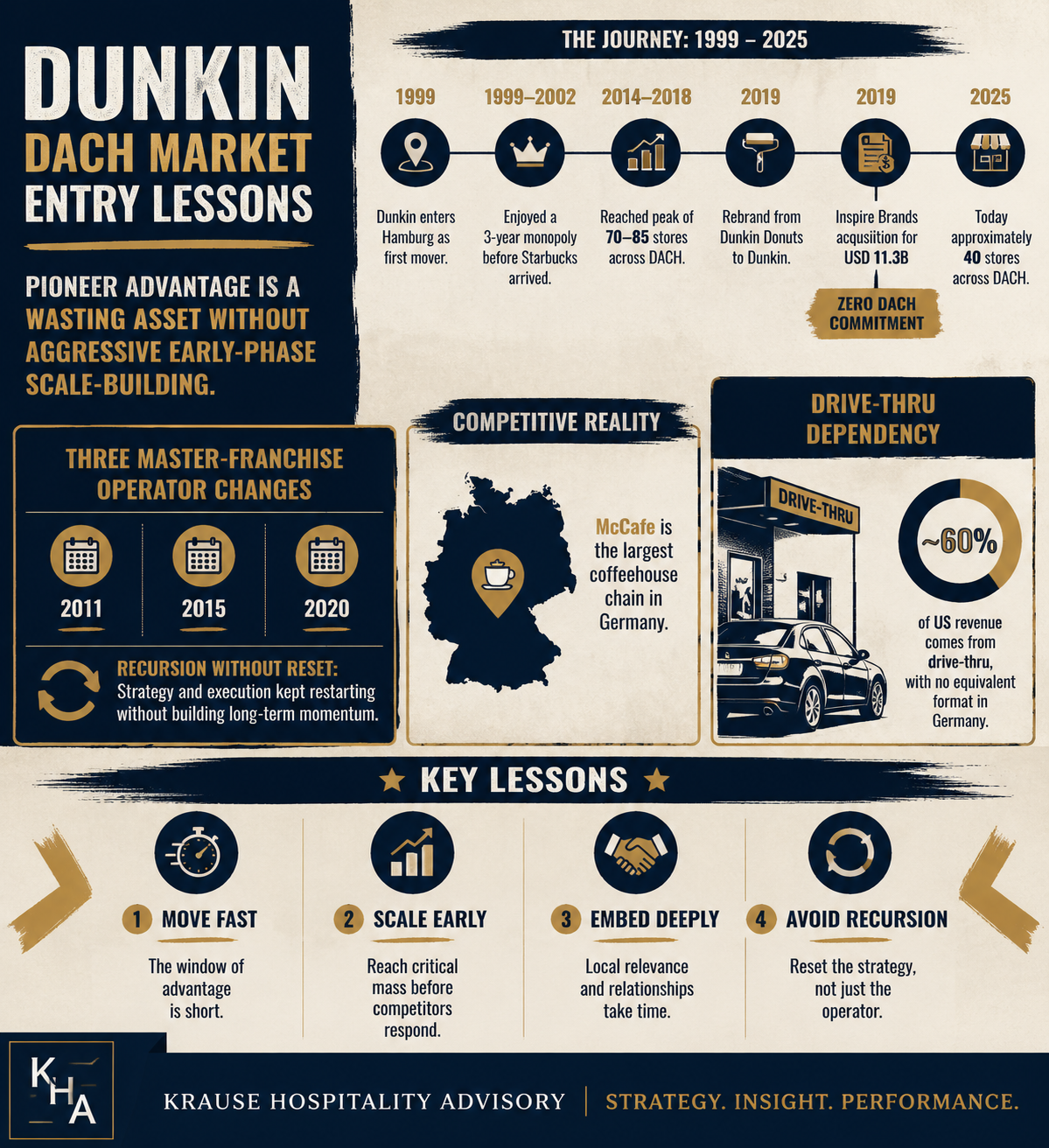
Today there are roughly 40 Dunkin' stores left in Germany, down from a peak of 70-85 around 2017/18. Austria is functionally gone. Switzerland never had more than airport licences. The brand is still present, never formally exited, and dormant under Inspire Brands / Roark Capital ownership.
This is what the category-pioneer curse looks like in real time.
What we see
A first mover with a three-year monopoly that never converted into category ownership. Multiple master-franchise rotations – at least three documented operator changes between 2011 and 2020 – without a single one resetting the underlying problem. A 2018/19 global rebrand from "Dunkin' Donuts" to "Dunkin'" that arrived in DACH 17 years too late to recapture the coffee narrative McCafé and Starbucks had already taken.
What it tells us
Pioneer advantage is a wasting asset. Three years without competitors is only valuable if those three years are spent building scale, cultural embedding, and category association. Dunkin' opened three to five stores per year between 1999 and 2002 – too slow to become the category-definer, too cautious to lock in mindshare. By the time capital-rich competitors arrived, the window had already closed and the operator was too small to defend it.
Why it matters now
Inspire Brands signals no DACH priority. The same parent that runs Arby's, Sonic, Buffalo Wild Wings and (since 2024) Subway has not allocated capital toward a Dunkin' German turnaround. That is information for two audiences: anyone evaluating a master-franchise role for a US chain entering DACH, and Restaurant Brands International (Tim Hortons' parent), which continues to keep Tim Hortons out of Germany. The same category, the same barriers, and Dunkin's slow decline as the live evidence.
Stagnation by design: the slow-walk pioneer phase (1999–2002)
Three years of category exclusivity. Three to five new locations per year. By 2002 – the moment Starbucks landed in Germany – Dunkin' had perhaps a dozen stores in a country of 80 million people. The first master franchisee operated as an owner-operator, not as a category builder. The pioneer phase ran on owner-operator pacing, not on the capital allocation a land-grab would have required.
A genuine category land-grab in 1999-2002 would have meant 50-plus stores, regional clustering, and aggressive cultural positioning before the competitive set arrived. Instead the operator treated DACH as a handful of urban experiments. When Starbucks landed in 2002 and McCafé began rolling out in 2003, Dunkin' had neither the footprint to dominate the category nor the focus to own a defensible niche.
The category problem nobody could franchise around
The German breakfast market is unfriendly to the Dunkin' product logic at the level of consumption habit. Berliner and Krapfen are occasional pastries, not weekday breakfast. Filter coffee is consumed at home or at the bakery. Drive-thru morning coffee – roughly 60% of US Dunkin' revenue – has no equivalent in German consumption patterns.
That mismatch cannot be solved by operational excellence. It sits underneath every master-franchise rotation since 2011: each new operator inherits the same product-category gap, runs the same playbook, and produces the same plateau.
Master-franchise rotation as a strategy is recursion without reset. The German market did not change between operator handovers. The product did not change. The competitive set did not change. Only the name on the franchise agreement changed – and the franchise name has never been what failed.
Three operator handovers, one structural problem
The documented sequence:
- circa 2011/12 – first master-franchise change; new operator inherits 20-30 stores
- 2014-2018 – accelerated expansion under second master to a peak of 70-85 stores; aggressive shopping-centre and station-format rollout
- 2019-2020 – third operator change overlapping with COVID; closures begin
- December 2020 – Inspire Brands acquires Dunkin' Brands globally for USD 11.3 billion; Roark Capital becomes de facto owner; DACH not prioritised
- 2021-2025 – silent contraction from approximately 55-65 to roughly 40 stores; no formal exit communication
Every handover was the same trade: capital-in for a network the previous operator could not turn profitable. Every handover then encountered the same constraint set. The 11.3 billion-dollar Inspire transaction did not change DACH outcomes because DACH was never what the deal was underwriting.
The rebrand that arrived too late
In 2018 Dunkin' Brands announced the global pivot from "Dunkin' Donuts" to "Dunkin'", repositioning the brand around coffee-first, donut-secondary. Strategically correct: in the US, beverage already drove most transactions. The 2019 rollout in DACH was delayed and undercommunicated.
The deeper problem: by 2019 McCafé had been the largest German coffeehouse brand for over a decade. Starbucks owned the premium third-place position. Dunkin' attempted to pivot to coffee-first credibility against two operators who had spent 17 years building it. The category narrative was already written, and the rewrite did not land.
The Tim Hortons-shaped silence
The other side of this case lives at Restaurant Brands International. Tim Hortons – near-identical product (coffee-and-donut QSR), strong heritage cultural associations in its home market, US footprint expansion well underway – has not entered Germany. Not under 3G Capital ownership. Not under RBI. Not opportunistically.
The constraints Dunkin' has been running into for 27 years are visible to RBI in real time. The decision to stay out is not absence of strategy. It is the same read, reached independently.
For US chain CEOs evaluating European entries, Dunkin's slow contraction is consultable evidence: the German breakfast-coffee category is not a distribution problem, an operator problem, or a brand-awareness problem. It is a category-fit problem. No franchise structure, no capital injection, no rebrand has reversed it across three decades and three master franchisees. That should set the prior for anyone underwriting a similar entry.
What to read first
Dunkin' DACH is what happens when a chain mistakes visibility for fit. The market was visible: leftovers from US travel, post-cold-war urban experimentation, Friends-era cultural openness. None of that is the same as a daily breakfast-pastry category that German consumers were ready to adopt at scale.
The pioneer-vacuum reading was correct in 1999. The category-fit reading was wrong. The 27 years since have been the cost of confusing the two.
For any US operator considering DACH, and for any DACH master franchisee considering a US-coffee licence, the question is the same one we have argued in adjacent cases. Is the market ready, or does the category exist? These are two separate questions, and almost nobody separates them cleanly.
Sources
- Inspire Brands / Roark Capital press releases on Dunkin' Brands acquisition (October/December 2020)
- Dunkin' Brands Group 10-K filings 2011-2020 (NASDAQ: DNKN)
- AHGZ / Foodservice / Food Service Deutschland – master-franchise reporting on Dunkin' Germany (2011-2020)
- ScrapeHero / store-locator analysis: current Dunkin' Germany footprint estimate (~40 stores, 2025)
- Wikipedia: Dunkin' / Dunkin' Donuts brand history and 2018/19 rebrand
- Background: McCafé Germany rollout 2003; Starbucks Germany entry 2002