2.1 The thesis — capital-window pivot
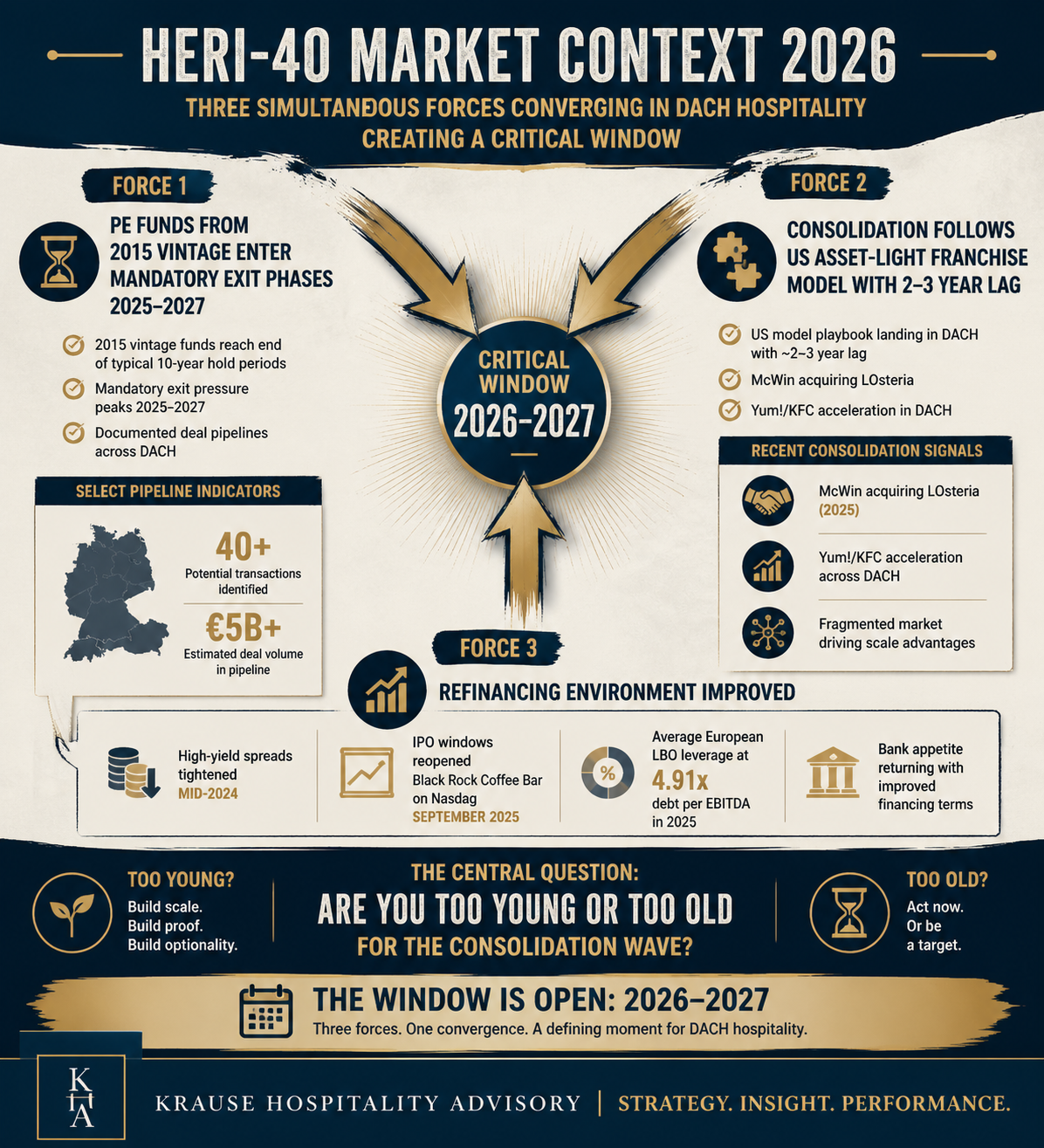
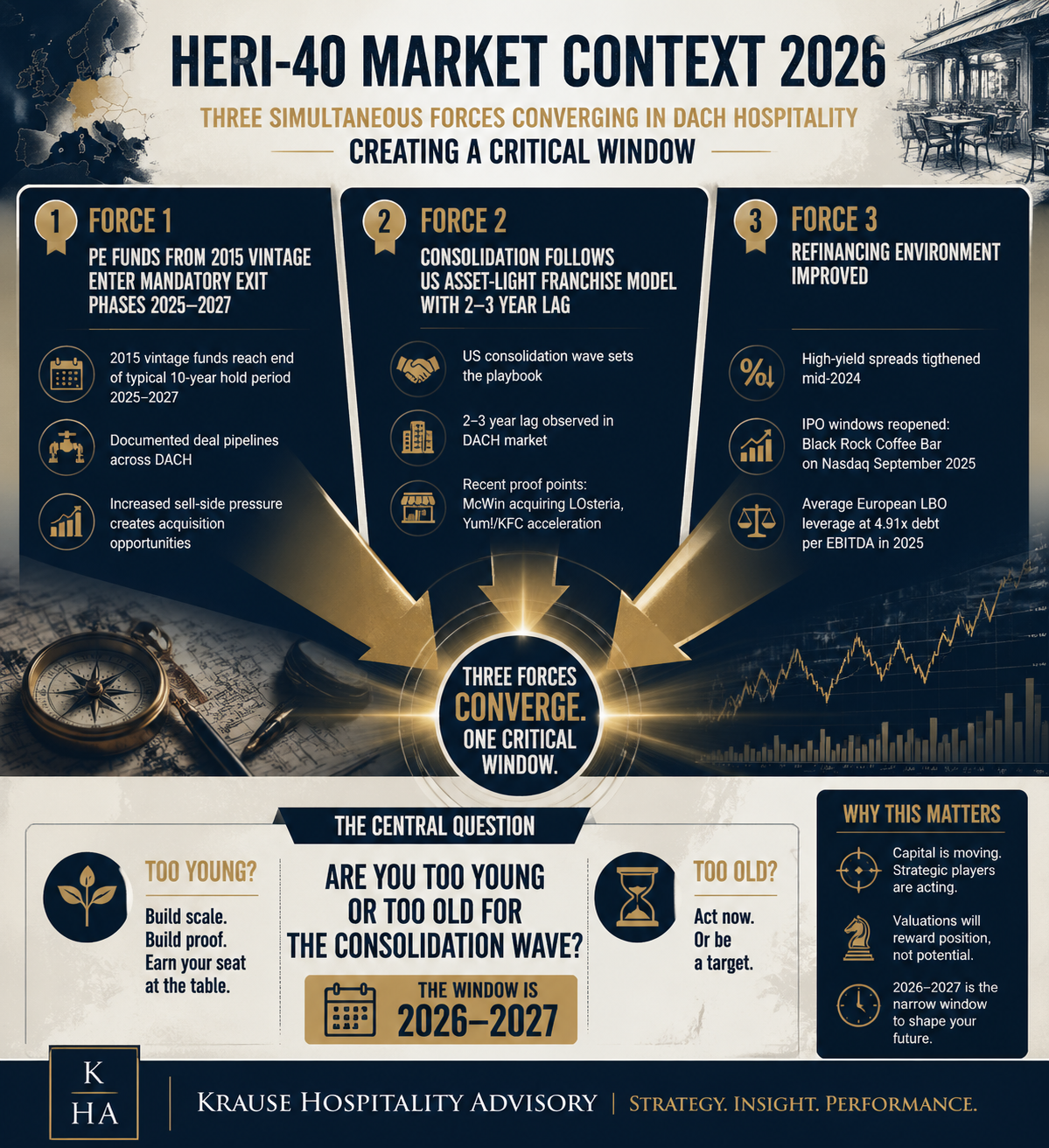
2026 is not a continuation of 2018 through 2024. For multi-unit operators in DACH hospitality, the window between exit opportunity and structural compulsion shifts noticeably this year — because three independent developments are, for the first time, pulling in the same direction at the same time. Those three are vintage pressure inside PE funds, the DACH consolidation catch-up, and a refinancing climate that has begun to move again. The operative metric here is simultaneity, not the size of any single shift: two of the three developments were visible in any given year between 2018 and 2023, but 2026 is the first year in which all three are significant and tangibly DACH-specific at the same time.
The first shift is PE pressure. The large hospitality investors of the 2015-vintage fund generation — Roark Capital, Bain Capital, Sycamore, L Catterton, General Atlantic — are entering the exit phase of their classic ten-year fund tenors between 2025 and 2027. A fund raised in 2015 needs realisations beginning in 2025 to meet its own LP commitments. That sets in motion a sell-side pipeline that has been publicly documentable since mid-2024.
The second shift is DACH consolidation. The US model of asset-light franchise multiplication — perfected from Inspire Brands through Roark to RBI — is reaching the German-speaking market with a two-to-three-year lag. McWin's 2023 acquisition of L'Osteria, the KFC acceleration under Yum!, and the market entries of several US concepts in 2024–2025 are markers of the same movement.
The third shift is the refinancing climate. After two years of high interest rates, high-yield spreads are moving again, the IPO window opens and closes on a quarterly cadence, and innovative financing structures — whole-business securitisation among them — are within reach of mid-market operators for the first time.
Each of these three shifts is individually explicable and documented. Their simultaneity is new. 2026 is the first year in which all three become tangible for DACH operators at once. The next four H2 blocks look at each shift in detail and then translate it into the operative question it raises for your chain.
2.2 PE pressure — vintage logic drives exits
Private equity funds run on a life-cycle logic that triggers a growing volume of hospitality exits on a calendar schedule, independent of the macro cycle.
The classic PE fund structure carries a ten-year tenor: five years of investment, three to five years of holding, the final two to three years dedicated to exit and the return of capital to limited partners. Funds raised in 2015 — and many of the hospitality positions of the last consolidation wave sit inside that vintage — enter their mandatory exit phase between 2025 and 2027. They have to sell, because LP agreements allow only limited extensions and fund-of-funds structures carry their own reporting cycles. That pressure is not macro-dependent.
The documented pipelines of the past 18 months reflect it. Houlihan Lokey reported an increase in hospitality mandates in H1 2025 versus the prior-year comparison. Focus Investment Banking noted in its Agribusiness Quarterly Q3 2025 that foodservice deals represent the strongest single category in ten years. Hyde Park Capital documented in its Winter 2024 report the growth of the hospitality dealflow pipeline against broader market weakness.
At the same time, the large players publish their hospitality movements themselves. Roark Capital (among others: Inspire Brands with Arby's, Buffalo Wild Wings, Sonic, Dunkin', Jimmy John's; Culver's; CKE Restaurants) has actively restructured its portfolio since 2022.
Three transactions in the last twelve months show the pattern concretely. In Europe, Maj Invest Equity sold its ten-year majority stake in Sticks'n'Sushi (27 sites across Denmark, the United Kingdom, and Germany, approximately GBP 90 million annual revenue) to McWin Capital Partners in late January 2024. According to the Financial Times of 31 January 2024, enterprise value came in at approximately EUR 80 million for 95% of equity — a clean ten-year vintage exit with a DACH component, in which a European growth-PE fund hands off to a hospitality-specialist platform builder.
In the United States, Levine Leichtman Capital Partners sold Tropical Smoothie Cafe (more than 1,400 sites across 44 US states) to Blackstone in April 2024 for approximately USD 2 billion including debt — a sponsor-to-sponsor exit confirmed simultaneously by Reuters and the Wall Street Journal on 24 April 2024. In December 2024 the Sizzling Platter deal followed (a multi-brand franchisee for Little Caesars, Wingstop, and Dunkin' with more than 800 sites) from CapitalSpring to Bain Capital for over USD 1 billion including debt. At an EBITDA figure of approximately USD 175 million reported by Reuters on 17 December 2024, that implies an EV/EBITDA multiple north of 5.7×.
Three distinct patterns in twelve months: a vintage exit with European leadership, a secondary buyout between two US sponsors with majority transfer to a mega asset manager, and a multi-brand franchisee sale with debt refinancing. The pipeline is therefore not speculative — it is legible in quarterly filings and in daily business-press reporting. For DACH operators, what matters is less the absolute deal size than the implicit buyer taxonomy: which of these archetypes — specialist hospitality platform builder, mega-sponsor with a foodservice vertical, credit-oriented franchisee consolidator — is already active in your segment, and what level of operational maturity does that buyer demand as the entry ticket?
For DACH operators, this means two things. First, the buyer market is moving. Strategic acquirers become more active because individual PE funds trim their portfolios and strategic competitors pick up the released brands. Second, PE sponsors themselves operate in a dual role — sellers on old vintages, buyers on new funds that have to put fresh capital to work. Hospitality-oriented funds raised in 2023 and 2024 are under pressure to deploy dry powder.
What matters concretely for a DACH operator: the question of which PE sponsor is today the most probable buyer for your segment shifts every six months. MTS component B3 (strategic buyer interest signals) in Section 5 shows how to track that rotation quarterly yourself, without expensive database subscriptions.
2.3 DACH consolidation — the US model arrives with a lag
The second shift is the DACH-specific consolidation wave. It is not a new trend but the delayed arrival of the US model that has shaped American hospitality since roughly 2012: asset-light franchise multiplication under a PE roof, paired with aggressive consolidation into holding structures.
Inspire Brands under Roark Capital brought Arby's, Buffalo Wild Wings, Sonic Drive-In, Jimmy John's, and Dunkin' onto a single platform of more than 30,000 sites between 2018 and 2021. Restaurant Brands International consolidated Burger King, Tim Hortons, Popeyes, and Firehouse Subs. The model is easy to describe: a central services hub, decentralised franchise operations, multiple expansion through system growth rather than single-unit performance. The average sub-segment multiple rises because the platform itself becomes institutionally attractive.
DACH shows the same movements — with a two-to-three-year lag and a different starting base. McWin Partners acquired the L'Osteria group in 2023, at an industry-estimated deal volume of over EUR 220 million, and has since explicitly pursued European roll-up. Yum! Brands has been visibly accelerating KFC DACH expansion since 2024, in both Germany and Austria, with double-digit annual openings in individual regions. Roark Capital is already present in DACH through its portfolio brands and conducts ongoing market soundings.
The other side of the coin is equally documented. Vapiano as a 2020 distressed wind-down, several smaller chained-foodservice operators between 2021 and 2024 filing for insolvency or accepting minority rescues, casual-dining concepts in structural crisis. Consolidation does not mean that every chain is sold — it means that the middle of the market thins out. Either build toward an institutionally attractive platform, or retreat into niche positioning, or wind down. The middle is ground down systematically.
For DACH operators with 20 to 200 units, this translates as follows: you are not facing the question "sell or continue", you are facing the question "which platform role". Three patterns are crystallising:
- Integration into an existing system. A PE platform or strategic acquirer takes over your brand; you become part of a larger portfolio with shared services. Typical structure: earnout, multi-year management agreement, integration into the buyer's services infrastructure.
- Consolidator role. You yourself acquire smaller players in your segment to build a proprietary platform that is later sold to a PE sponsor — the classic buy-and-build strategy. This presupposes operational management capacity that not every founder-CEO wants to supply.
- Niche stability. You deliberately stay smaller, optimise single-unit profitability, and forgo the platform multiple. A valid option, but with a clear sacrifice of the 15× plus corridor.
HERI-40 does not evaluate which role is right. That is an entrepreneurial decision, dependent on family situation, management motivation, and capital requirements. HERI-40 evaluates which role your current operating structure — plus the current market phase — most plausibly permits.
2.4 Refinancing climate — rates, IPO windows, new structures
The third shift concerns the financing environment — and it is the most mobile of the three.
Between 2022 and 2024, rising interest rates compressed multiples downward. Leveraged-buyout acquirers refinance a portion of purchase prices via debt. When debt costs rise, the maximum price a buyer can offer at the same target return falls. Focus Investment Banking has quantified the correlation: a 100-basis-point rate change shifts hospitality EV/EBITDA multiples by approximately 0.5 points on average. At current sub-segment medians between 6× (lower-middle-market) and 17× (premium QSR), that is a lever that moves individual deals by 10 to 30 percent.
In 2026 the rate picture is moving again. High-yield spreads — the metric that tells LBO acquirers the conditions under which they can refinance — have tightened again since mid-2024. IPO windows open and close on a quarterly cadence. The Bain M&A Report 2026 documents the strongest rise in deal activity in consumer sectors since 2021. These are not forecasts — they are observations from the past four quarters.
Beyond the rate lever, new financing structures have become relevant for mid-market operators in 2025 and 2026. Whole-business securitisation (WBS) — a securitisation of all cashflow-generating parts of a franchise chain — became visible to a broader audience with the 2023 Subway transaction, structured at over USD 5 billion. Relevant for DACH operators: WBS is not a pure US phenomenon. Individual European franchise systems are already evaluating similar structures. That shifts the composition of the buyer universe. Classic PE fund structures now compete with new vehicles that can carry higher leverage ratios and therefore bid higher gross purchase prices.
Four verifiable markers from the current cycle show the direction. First, at the equity end of the capital structure: the IPO of coffee chain Black Rock Coffee Bar on the Nasdaq Global Market (ticker BRCB) on 12 September 2025 priced at USD 20 per share, above the originally communicated range of USD 16 to 18. The issue raised approximately USD 294.1 million at a valuation of approximately USD 956 million at the IPO price, on a base of 158 sites across eight US states. On the first trading day the share price rose approximately 37% to USD 27.53, which per Bloomberg lifted market capitalisation through the USD 1.3 billion mark. Lead bookrunners were J.P. Morgan, Jefferies, Morgan Stanley, and Baird. A hospitality-adjacent consumer IPO of that scale simply was not realisable in the 2022–2023 phase; the case demonstrates that the IPO window for credible concepts with a clean unit-economics story was open again in Q3 2025.
Second, on the debt side: the ICE BofA US High Yield Option-Adjusted Spread rose according to the FRED time series from approximately 292 basis points at the start of 2025 to an April peak of approximately 460 basis points in the wake of the so-called "Liberation Day" tariff announcement in early April 2025 — the strongest widening since the banking stress of spring 2023. By 31 March 2026 the spread had tightened back to 328 basis points, but remained above the two-year low. That mirrors the typical peak-to-reopening dynamic of a refinancing window: a sharp spread widening on uncertainty, a gradual tightening once deal activity returns and investors rebuild risk appetite.
Third, on the leverage side: PitchBook documented in its European Buyout Update at the end of January 2026 a rise in average total-debt/EBITDA for European LBO transactions from 4.58× (2024) to 4.91× (2025), the strongest year-over-year jump in several years. That figure must explicitly be read as a European buyout total proxy, not a hospitality-only time series — a cleanly delineated hospitality debt/EBITDA series is not currently consolidated in public sources. For hospitality transactions specifically, Houlihan Lokey describes realistic structures around 8× EBITDA with 3× to 4× leverage in its H1 2025 hospitality sector update, in its own words: "Valuations are increasingly realistic: 8x EBITDA with 3x-4x leverage sounds a lot better than >10x with no debt." — a noticeably more disciplined level than the greater-than-10× deals of the low-rate phase 2019 to 2021, but once again financeable.
Fourth, on the public-markets side of hospitality valuation: Houlihan Lokey documents in the same H1 2025 update a growth in European hospitality deal volume of approximately 12% year-on-year (Mergermarket data), with a particularly pronounced movement in the United Kingdom of plus 25%. Within the 18 months preceding the report date, six public-to-private transactions were executed in UK hospitality — among them the sale of the Loungers group to Fortress Investment Group in December 2024 at an enterprise value of GBP 367 million, a 9.4× EBITDA multiple, and a 37% premium to the pre-announcement closing price. P2P activity is the classic indicator of a delta between public-market valuation and private willingness to pay — and it is at a multi-year high in European hospitality.
These four markers are framed by a fifth, slower signal: the policy-rate path. The Bank of England cut its policy rate to 4.5% in February 2025 and, per the Houlihan Lokey update, projected three further cuts to approximately 3.75% by year-end 2025 — not a rate reversal, but a discernible easing. That is the sustaining background score of the deal window, which makes each of the four foreground movements possible in the first place.
The four markers do not all point in the same direction at the same moment. IPO windows open in bursts, high-yield spreads move continuously, leverage ratios adjust with a quarterly lag, and P2P premia form bilaterally. Precisely for that reason a single number does not constitute a refinancing climate — only the aggregation of the four indicators carries as a window reading, and only that aggregation is the reason MTS component B4 in Section 5 combines four sub-scores rather than reducing to a single marker.
What this means practically for operators: the buyer pool has expanded. In 2018 it was strategic acquirers plus classic PE sponsors. In 2026 it is strategic acquirers, classic PE, infrastructure-oriented funds, family offices with a hospitality focus, and — in select cases — structured buyers with WBS financing. But more buyer types do not automatically mean higher multiples. They mean that your seller position becomes more differentiated: which buyer type pays for which of your attributes? A strategic acquirer pays for consolidation synergies. A PE sponsor pays for reproducible scaling. A family office pays for stable cashflow and management continuity.
MTS component B4 (capital-markets window) in Section 5 operationalises exactly this read. Instead of a qualitative "is the window open?" assessment, it delivers a score generated from four publicly available indicators: IPO volume over the trailing 90 days, high-yield spread movement, number of closed hospitality LBOs in the quarter, and average debt/EBITDA ratio on those deals.
Edge case for context: the Subway deal referenced above sat in 2023 with an estimated HERI-40 between 127 and 142, in the Standard band. It still closed, and in the billions. The reason lay in MTS component B4, not in the ORS. The WBS financing made the deal structurally possible even though operational maturity was not Premium. That is an edge case, not a blueprint: it shows that MTS can rescue individual deals, but not as a rule.
2.5 The self-diagnosis gap
The first shift explains why more deals are happening. The second, which role you can play in the market. The third, which buyer types negotiate with which financing. What is missing is the instrument that lets you, as an operator, translate those three factors into your own position.
Today three options are available to you — each with a specific weakness.
The first option is engaging an M&A advisor or an investment bank for a pre-mandate analysis. The quality is high, costs typically land between EUR 30,000 and EUR 100,000 for an initial opinion, and the gatekeeper effect is tangible: the advisor will fit you into a pre-built narrative template that aligns with their own buyer pipeline. You receive an assessment, but not an independent methodology you can reproduce yourself or defend to a board.
The second option is instinct. An experienced founder-CEO or long-tenured managing director carries a reliable feel for their own chain and the market. The weakness is reproducible communication: instinct cannot be cleanly substantiated to a board, a family office, or a potential buyer. Nor can it be compared across two managing directors.
The third option is the ad-hoc spreadsheet. The CFO builds an Excel file with multiples comparisons and peer-group benchmarks. Quality depends massively on which data base is available and how peer selection is executed. Two different CFOs would produce two different results, and both would be defensible.
What is available on the market in terms of published tools does not close this gap. EY-Parthenon has published the EVO framework for hospitality exits — it is an advisor playbook, not a self-service score. The Restaurant Finance Monitor regularly publishes the "banana-peel" checklist of typical exit pitfalls — useful as a checklist, but without quantitative aggregation. PitchBook and Mergermarket offer sub-segment multiples — but only as point estimates, without cross-tabulation against readiness.
A systematic 2025 search in peer-reviewed hospitality journals (Cornell Hospitality Quarterly, International Journal of Hospitality Management), advisory publications (EY-Parthenon, AlixPartners, McKinsey, BCG), industry associations (DEHOGA, NRA, UKHospitality), and location-intelligence platforms (Buxton, SiteZeus, Placer.ai) produced no equivalent. The closest proxy is EY EVO as an advisor playbook — not a self-service score.
HERI-40 is the attempt to close that gap. Not with a banker substitute, but with a self-diagnostic instrument you can run yourself before engaging a banker — or as a second opinion alongside a banker's report.
2.6 The window question
Taken together, the three shifts collapse into a single operative question for your chain.
Over the next 12 to 18 months, are you too young or too old for the consolidation wave?
"Too young" means: your internal operational maturity has not yet reached the level Premium buyers require. You enter the market at a valuation discount, because you cannot visibly demonstrate the consistency or management depth of a mature system.
"Too old" means: your chain is operationally mature, but the market window has already closed. The PE fund vintages have completed their exits, the consolidation wave is no longer active in your segment, and you negotiate into a thinned-out buyer market.
"Just right" means: ORS and MTS are simultaneously in Premium territory. That is the Platinum zone from Section 1.3 — the condition in which Dutch Bros went to market in 2021 and Jersey Mike's went to market in 2024.
The remaining sections of this paper give you the tools to answer that question with numbers. Section 4 decomposes operational readiness into five sub-components you can compute from the data inside your own chain. Section 5 decomposes the market window into four sub-components derivable from publicly available indicators. Section 6 translates the combination into one of the four zones. Section 7 walks the full calculation on a worked example.
The question "how exit-ready is your chain?" becomes answerable — not perfectly, but reproducibly.
Related research
- The roll-up playbook in European hospitality: where multiple arbitrage still works
- Parent-company DNA as a valuation variable: KFC Germany and Taco Bell's USD 60 million miss
- Multiple compression in mid-market foodservice: reading the 2024–2025 corridor
- HERI-40 Section 1: Executive Summary
Sources
- Financial Times, 31 January 2024: Sticks'n'Sushi sale to McWin Capital Partners
- Reuters and Wall Street Journal, 24 April 2024: Tropical Smoothie Cafe sale to Blackstone
- Reuters, 17 December 2024: Sizzling Platter sale to Bain Capital
- Houlihan Lokey, H1 2025 Hospitality Sector Update
- Focus Investment Banking, Agribusiness Quarterly Q3 2025
- Hyde Park Capital, Winter 2024 Report
- Bain & Company, M&A Report 2026
- PitchBook, European Buyout Update, January 2026
- FRED: ICE BofA US High Yield Option-Adjusted Spread time series
- Bloomberg, 12 September 2025: Black Rock Coffee Bar (BRCB) Nasdaq IPO
- SEC filings, Black Rock Coffee Bar S-1
- Mergermarket: European hospitality deal volumes, H1 2025
- EY-Parthenon: EVO framework for hospitality exits
- Restaurant Finance Monitor: "banana-peel" exit checklist