Section 1 — Why DACH is not "continental Europe"
The German-speaking foodservice market — Germany, Austria, and Switzerland — is routinely treated as a single block of "continental Europe" inside the strategy decks of foreign restaurant chains. The block has just over 100 million inhabitants, the second-largest hospitality GDP in the Eurozone after France, and a chain penetration rate that lags the United States by roughly 25 percentage points. That gap, in the deck, looks like opportunity.
The deck is right on the headline and wrong on the operating environment. DACH does not behave like a single continental-European block. Four legal-and-fiscal facts — none of them visible in the IFRS line items most acquirers benchmark on — change the unit economics of any foreign chain entering the territory. They show up not in the prospectus but in the operating P&L of the seventh location, after the first six performed.
This brief documents the four facts that recur in advisory engagements with US, UK and Asian chains evaluating DACH entry. It is not exhaustive. It is the short list of differences that have, in our case files, been the difference between a sub-segment leader and a sub-five-store withdrawal.
Section 2 — Germany's Tarifrecht
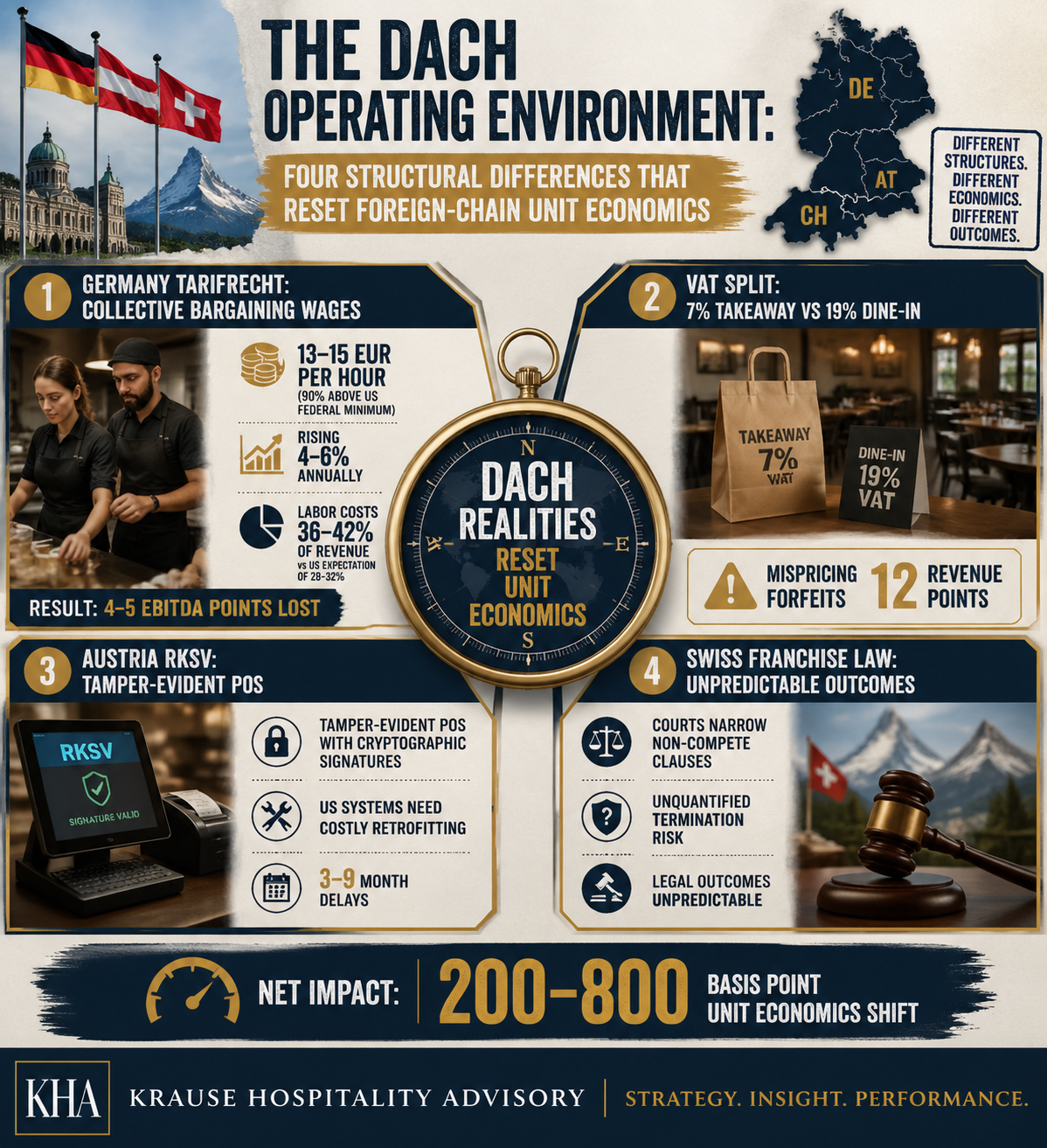
The Tarifvertragsgesetz of 1949, in its current form, governs how wages are set in German hospitality. The relevant fact for a foreign operator is this: a regional collective bargaining agreement — a Tarifvertrag — signed between NGG, the food and hospitality union, and DEHOGA, the industry association, sets a wage floor that, in the majority of federal states, is binding on non-signatory employers via Allgemeinverbindlichkeit declarations. The wage floor moves with the agreement, not with the local labor market.
For an operator accustomed to a flexible hourly wage that follows local labor supply, this is structural. A franchisee in Munich cannot pay below the Bavaria-region Tariflohn on opening day even if local labor is abundant. The floor — currently in the 13 to 15 €/hour range across hospitality Tarif zones, increasing 4 to 6 percent annually under the most recent rounds — is roughly 90 percent above the equivalent US federal minimum and 25 percent above the average minimum wage of the EU-27.
The strategic consequence is not simply "labor costs more." The consequence is that any pro forma model built on US labor-cost ratios — typically 28 to 32 percent of revenue for casual chains — projects margins that the Tarif regime structurally precludes. Operators consistently land at 36 to 42 percent. The miss is not 4 to 5 percentage points on labor; it is the 4 to 5 percentage points carried straight through to EBITDA.
Section 3 — The 7%/19% VAT split
German VAT — Umsatzsteuer — operates on two rates relevant to foodservice: 7 percent reduced for food sold for take-away or with negligible hospitality service, and 19 percent standard for dine-in service. Austria runs a comparable split at 10 percent and 20 percent. Switzerland operates a different scheme entirely, with a low standard rate of 8.1 percent.
The fork is invisible to a foreign operator until the operator opens the first store. The German tax authority — the Finanzamt — draws the line at "predominantly hospitality service," operationally interpreted as: tables, plates, cleaning, climate control. A burger sold at a counter-only pickup window: 7 percent. The same burger sold at the same counter and eaten on a stool inside the same store: 19 percent. The same burger sold at a drive-through: 7 percent. The same burger delivered: 7 percent.
The mechanic forces a question that does not exist in the US deck: does the format favor a 7 percent or 19 percent revenue mix, and does the entire menu pricing strategy shift accordingly? A QSR that runs an 80 percent take-away mix runs a fundamentally different price-sensitivity calculation than a casual-dine concept landing at 30 percent take-away. Foreign operators consistently misprice on entry — typically pricing the dine-in menu as if it carried the reduced rate, leaving 12 points of revenue on the table on every dine-in transaction.
The 2020 Covid-era reduction, which temporarily moved dine-in to 7 percent through end-2023, and its reversal in January 2024 made the split sharper, not gentler. Pricing strategies built during the reduction had to be re-engineered against the standard rate inside one quarter.
Section 4 — Austria's Registrierkassen regime
Austria's Registrierkassensicherheitsverordnung — RKSV — of 2017, amended through 2026, requires every operating business with annual turnover above €15,000 and at least €7,500 in cash transactions to operate a tamper-evident, signature-chained electronic cash register. Each receipt carries a cryptographic signature linking it to the previous receipt. Tax audits download the chain, verify its integrity, and, in confirmed tampering cases, levy retroactive tax liability against the company plus criminal-fraud charges against the responsible executives.
A foreign chain entering Austria with an off-the-shelf US POS — typically Toast, Square, or NCR Aloha as configured for the US market — does not meet RKSV by default. The tamper-evident chain requires Austrian-certified hardware modules, in practice a USB-based cryptographic device known as a Sicherheitseinrichtung, and registration of the device with the FinanzOnline portal. Operators that expand into Austria without re-platforming POS spend three to nine months in retrofit mode, often blocked by Austrian-side certification timelines.
The consequence is operational, not fiscal. The threshold catches every commercial format. The fix is not optional. The retrofit window — six months on the optimistic case — is six months in which the Austrian unit operates either non-compliantly or with hand-issued receipts. Both options have produced enforcement actions in our case files.
Section 5 — Swiss franchise contract law
Switzerland has no franchise-specific statute. There is no Swiss equivalent of the FTC Franchise Rule, the EU Vertical Block Exemption, or the body of German Markenfranchise jurisprudence. Franchise relationships fall under general Swiss contract law — the Code of Obligations, OR — combined with the Cartel Act, KG, for vertical-restraint analysis.
The absence of a statute is not, in practice, a regulatory advantage. Swiss courts apply general principles — good faith under Art. 2 ZGB, fair dealing in long-term contracts, and statutory protections for the economically weaker party — to franchise disputes. The result is unpredictable case-by-case interpretation. A franchisor accustomed to FTC Rule disclosures and standard franchisee-default termination clauses arrives in Switzerland with a contract template that Swiss courts have repeatedly trimmed in disputed terminations.
The specific exposure runs through post-termination non-compete enforcement and territorial-exclusivity carve-outs. Both clauses survive in US and most EU jurisdictions; both are routinely narrowed by Swiss courts. A franchisor running a 50-plus store Swiss network on a US-template agreement carries unquantified termination risk that the legal team can read but the operations team cannot.
Section 6 — What this means for foreign operators
The four facts above are not the entire DACH operating-environment dossier. They are the four that recur in advisory engagements with foreign chains evaluating entry. Each of them moves the unit economics by 200 to 800 basis points relative to a US-baseline model. Cumulatively, they explain a measurable share of why foreign chain entries to DACH disproportionately under-deliver against pro forma. Five Guys' contraction from eleven to six German stores between 2022 and 2025 is the most documented recent case. Carl's Jr.'s 2017 to 2019 Munich exit is another. Quiznos' 2008 to 2012 four-store withdrawal is a third.
The implication for entry strategy is not "do not enter." It is: model DACH unit economics from the DACH operating environment, not from a discounted US base case. Foreign chains that successfully reach 50-plus DACH units — McDonald's, Domino's, Subway, Starbucks, Burger King, KFC — uniformly built local pro forma models that priced in Tarif wage floors, the 7 percent and 19 percent split, the RKSV regime, and Swiss contractual idiosyncrasies before the second store opened. Chains that did not consistently reached the contraction phase before the breakeven phase.
HERI-40 readers will recognize the pattern. The ORS dimension — operational readiness, internal economics — is set by the chain's home market. The MTS dimension — market timing, external readability — is set by the entry market. DACH-specific operating facts compound the MTS calibration. They cannot be added to the home-market ORS without re-modeling the entire score against DACH-region inputs.
That re-modeling is the operative work product of an entry decision. It is not the work product of a pitch deck.